One of the first big decisions in any e-commerce project is also one of the most consequential: are you a store (you sell your own products) or a marketplace (many sellers sell through you)? Pick wrong and you either over-build a simple shop or under-build a platform. Here's the honest comparison.
1. The core difference
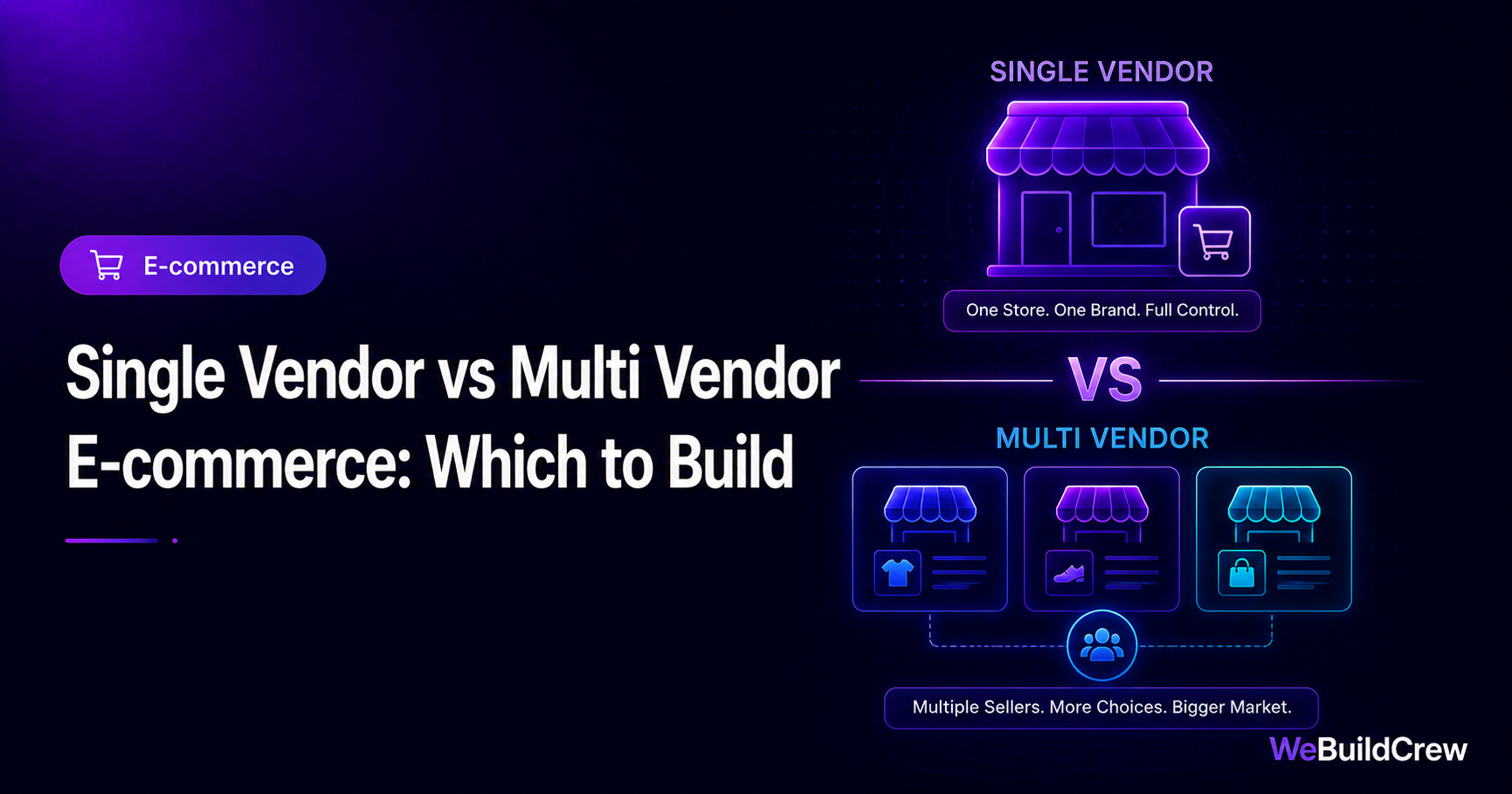
A single-vendor store sells your inventory: you control products, pricing, fulfilment and all the revenue. A multi-vendor marketplace lets independent sellers list and sell, while you take a commission and run the platform.
- Single-vendor
- Your products · your margin · simplest
- Multi-vendor
- Many sellers · commission · complex
- Key question
- Do you own the inventory or the network?
2. The data model tells the story
Multi-vendor adds a whole vendor dimension to every product, order and payout. That's the complexity in one picture:
model Product { id String @id @default(cuid()) title String price Int vendor Vendor? @relation(fields: [vendorId], references: [id]) // multi-vendor only vendorId String?} model Vendor { id String @id @default(cuid()) name String stripeAccountId String products Product[] commissionRate Float @default(0.1)}3. Payments & payouts differ massively
A single-vendor store collects money straight to you. A marketplace must split each payment between the platform and the right vendor — usually via Stripe Connect — and handle payouts, refunds and disputes per seller.
4. How to choose
- ✓You make/own the products → single-vendor store
- ✓You connect many sellers/providers → multi-vendor
- ✓Unsure but growing → start single-vendor, design for later
- ✓Validating demand → single-vendor MVP first
- Single-vendor timeline
- 2–5 weeks
- Multi-vendor timeline
- 8–16 weeks
- Related service
- E-commerce Solutions
Need this built? Explore our E-commerce Solutions service.
View service →Written by Zahid Ghotia · Published 5 March 2026 · 8 min read