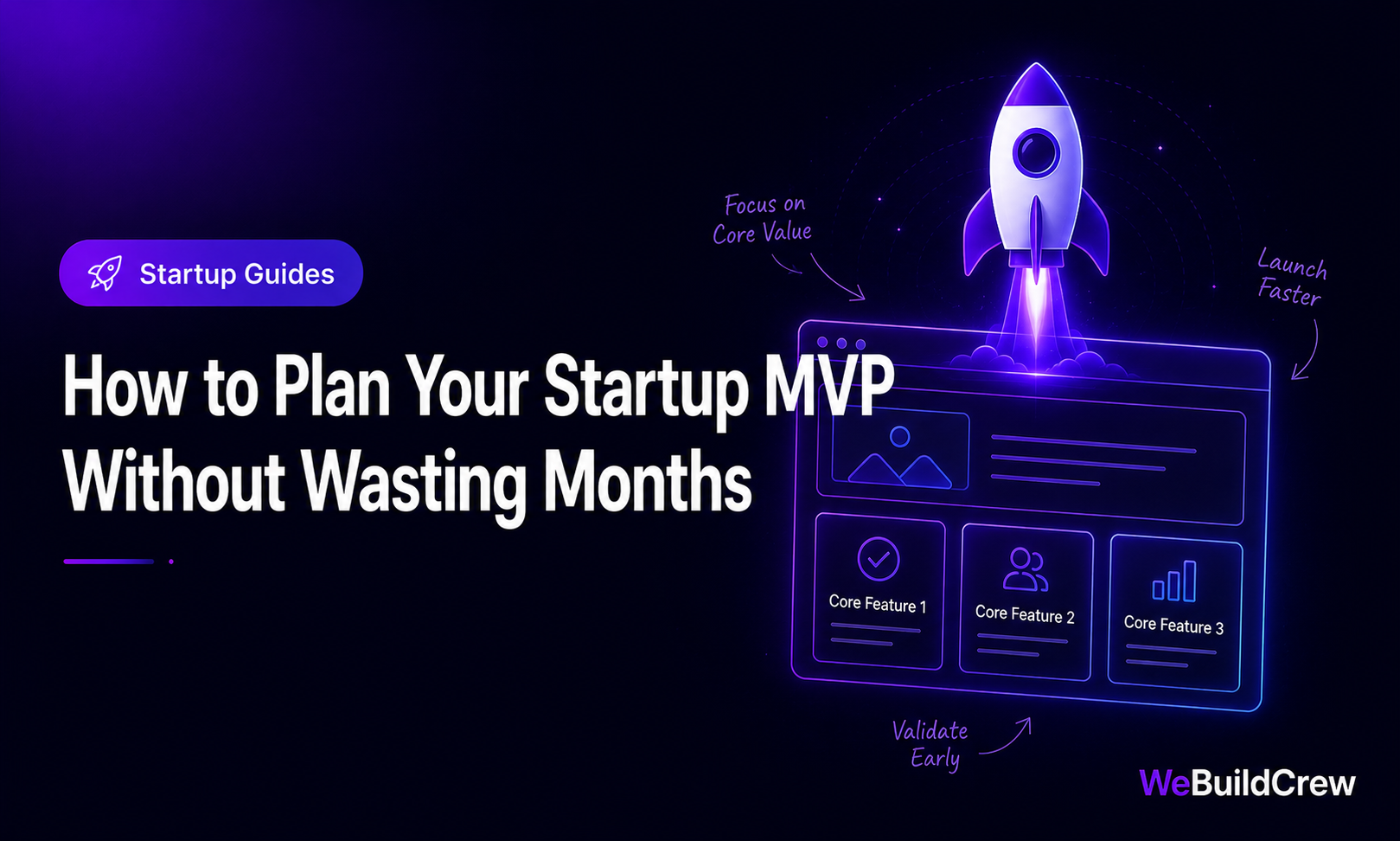
The biggest reason startups burn time and money is building too much before learning anything. A real MVP isn't a tiny version of your dream product — it's the smallest thing that tests your riskiest assumption with real users. Here's how to plan one.
1. Find your riskiest assumption
Every startup rests on a belief that might be wrong: that people want this, will pay for it, or will switch from what they use now. Your MVP exists to test that one belief — fast and cheap.
2. Scope ruthlessly
Write down every feature you imagine. Then cut everything that isn't required to test the core value. The list should feel uncomfortably small — that's correct.
- ✓One core user, one core job
- ✓The single workflow that delivers value
- ✓Just enough auth and data to be real
- ✓A way to charge or measure intent
- ✓Cut: settings, edge cases, 'nice to haves'
3. Build, launch, learn
- 1
Define the loop
The one path a user takes to get value.
- 2
Build the loop only
Ship the core, skip the rest.
- 3
Get real users
Watch what they actually do, not what they say.
- 4
Decide
Double down, pivot, or stop — with evidence.
- Estimated timeline
- 4–8 weeks
- Goal
- Validated learning, not features
- Related service
- SaaS Development
Need this built? Explore our SaaS Development service.
View service →Written by Zahid Ghotia · Published 2 December 2025 · 7 min read