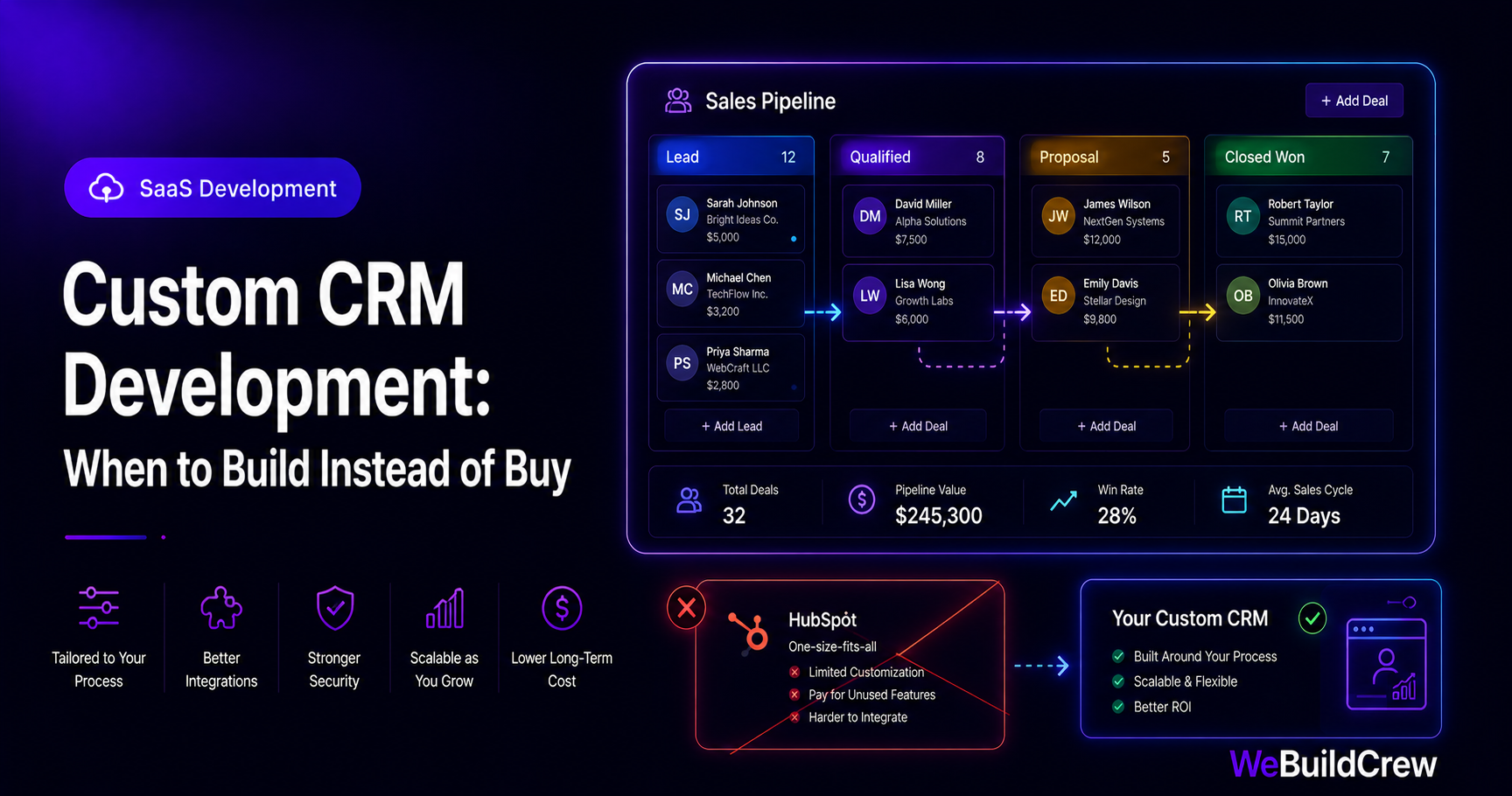
Every sales team has a process. Generic CRMs like HubSpot and Salesforce are built around the average process — which means every team with a non-average workflow ends up fighting the tool. Custom CRMs aren't for everyone, but for teams where the CRM genuinely shapes how deals get done, building beats buying.
When a custom CRM makes sense
- ✓Your pipeline has stages that don't map to standard CRM templates
- ✓You need deep integration with a proprietary backend or legacy system
- ✓Reps spend more time working around the tool than with it
- ✓You're paying for 80% of features you never use
- ✓You need white-label to resell CRM-as-a-service to your own clients
The core CRM loop
Every CRM does three things: captures leads, tracks them through a pipeline, and surfaces what to do next. Build this core loop first. Everything else — email sequences, reporting, integrations — is v2.
- 1
Capture
Lead comes in from form, email, API or manual entry — lands in inbox.
- 2
Qualify
Rep reviews and moves to the right pipeline stage.
- 3
Nurture
Tasks, notes and automated follow-ups keep deals moving.
- 4
Close
Deal is won or lost; reason logged for reporting.
The data model
model Contact { id String @id @default(cuid()) name String email String @unique orgId String deals Deal[]} model Deal { id String @id @default(cuid()) title String value Float stage String // lead, qualified, proposal, closed_won, closed_lost contactId String contact Contact @relation(fields: [contactId], references: [id]) orgId String updatedAt DateTime @updatedAt}Automation that saves hours
The highest-value automations in a CRM: auto-assign new leads by territory or round-robin, trigger a follow-up task when a deal stalls, send an email sequence when a lead reaches a specific stage, and alert the manager when a high-value deal goes quiet.
+30%
Rep productivity
−40%
Admin time
1
Source of truth
custom
Workflow fit
Need this built? Explore our SaaS Development service.
View service →Written by Zahid Ghotia · Published 11 June 2026 · 8 min read